
What is acid house? The TB-303 sound, explained
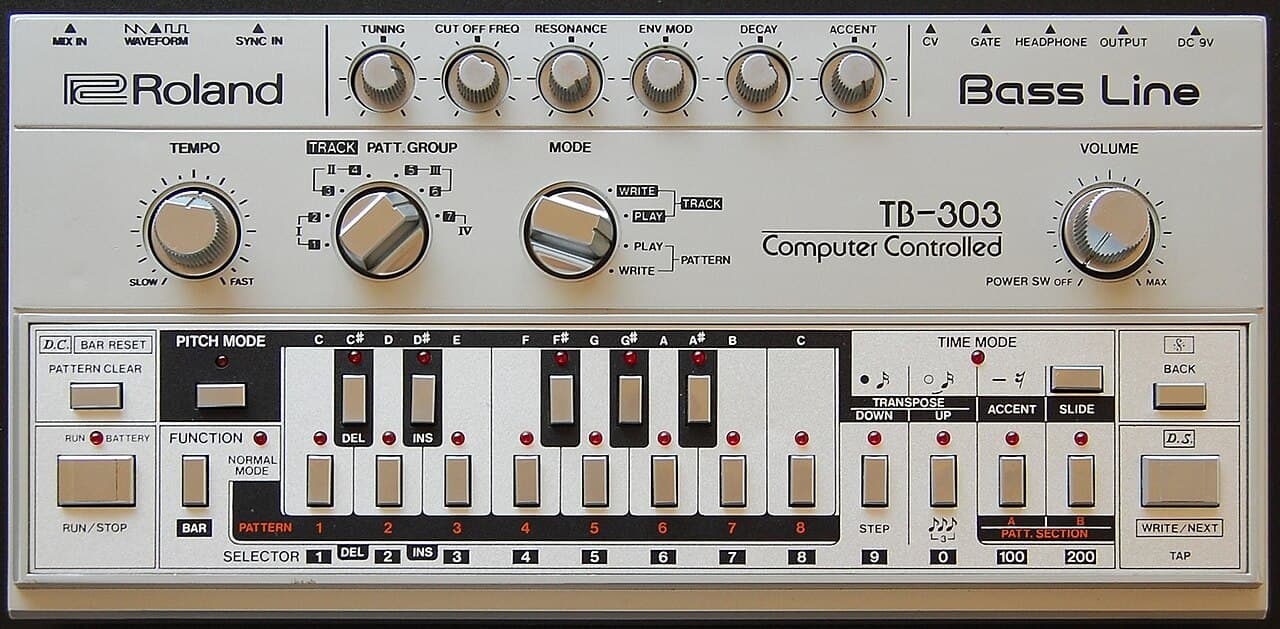
Acid house is the hypnotic, squelching branch of house music defined by the sound of the Roland TB-303 bass synthesizer rather than by a fixed tempo. It came out of Chicago in the mid-1980s — Phuture's "Acid Tracks," recorded around 1985–86 and released in 1987 on Trax Records, is the genre's founding record — and it went on to power the UK's 1988–89 "Second Summer of Love."
| Acid house | |
|---|---|
| Origin | Chicago, USA — mid-1980s |
| Defining sound | The Roland TB-303's filter-resonance "squelch," not a specific tempo |
| Typical BPM | ~120–130 (house's usual range — the 303 sound is what marks it out, not the speed) |
| Key track | Phuture, "Acid Tracks" (Trax Records, 1987) |
| UK breakout | The "Second Summer of Love," 1988–89 |
| Symbol | The smiley face |
In more detail
The Roland TB-303 Bass Line was released in 1981 as a cheap practice tool meant to simulate a bass guitar for solo musicians. It flopped — nothing about it sounded like a real bass — and Roland discontinued it in 1984. That failure is exactly why acid house exists: unwanted 303s became dirt-cheap on the second-hand market, and Chicago producers picked them up for reasons that had nothing to do with their original purpose.
DJ Pierre (Nathan Jones), of the group Phuture, got hold of one in the mid-1980s without fully understanding what it did. While a pattern played, he started turning the resonance and cutoff knobs to extremes — and discovered a squelching, bubbling, almost-vocal tone that didn't sound like anything else in dance music. Phuture — DJ Pierre, Spanky (Earl Smith Jr.) and Herbert Jackson, with production input from Marshall Jefferson — built a 12-minute track around it. Ron Hardy, the resident DJ at Chicago's Music Box (a rival room to Frankie Knuckles's Warehouse), was the first to play it out, and the crowd started calling it "Ron Hardy's Acid Track" for its psychedelic effect on the room. Released in 1987 on Trax Records as "Acid Tracks," it's now considered the record that started the genre.
The sound crossed the Atlantic fast. Acid house became the soundtrack to London's earliest illegal warehouse parties and clubs like Shoom, which opened in November 1987, and by the summers of 1988 and 1989 — now remembered as the UK's "Second Summer of Love" — it had exploded into a full youth movement of fields, warehouses and all-night raves. The smiley face became its visual shorthand, closely tied to the era's MDMA-fuelled club culture. One striking, well-documented side effect: acid house nights are credited with temporarily calming English football hooliganism, as rival firms found themselves dancing in the same rooms instead of fighting.
Acid house is a specific sound within house music, not a synonym for it — plenty of house never touches a 303. For the wider genre it sits inside, see what is house music.
How to recognise it in 10 seconds
- Listen for the squelch. A wet, rubbery, sliding bassline that sounds almost alive — that's the TB-303.
- Feel the instability. Resonance sweeps and pitch bends rather than a fixed, steady note.
- Count the chords. Usually none, or almost none — acid house is hypnotic and stripped-down, not melodic.
- Spot the culture. Smiley faces and warehouse-rave imagery, not polished club branding.
Related reading
- What is house music? — the wider genre acid house branches from.
- The history of house music — where acid house fits into the bigger Chicago story.
- See the full guide to house music subgenres for every comparison and deep-dive in one place.
FAQ
What is the Roland TB-303 and why does it matter to acid house? It's a bass synthesizer Roland released in 1981 and discontinued in 1984 after it failed commercially. Its "squelching" filter-resonance sound, discovered by Chicago producers experimenting with cheap second-hand units, became the defining sound of acid house.
Who made the first acid house record? Phuture — DJ Pierre, Spanky and Herbert Jackson — with "Acid Tracks," recorded around 1985–86 and released in 1987 on Trax Records. DJ Ron Hardy was the first to play it out, at Chicago's Music Box.
What was the "Second Summer of Love"? The UK's acid-house-fuelled rave explosion of 1988 and 1989 — warehouse parties, illegal raves and clubs like Shoom turned the sound into a mass youth movement.
Is acid house the same as house music? No — acid house is a specific sound within house music, defined by the TB-303's squelch, not a synonym for house as a whole. See what is house music.
Why is acid house associated with smiley faces? The smiley became the visual symbol of the UK acid house and rave scene from 1988 onward, closely linked to the era's MDMA-driven club culture.
Genre, track and timeline facts verified as of July 2026 against Wikipedia's "Acid house" and "Acid Tracks" entries and MusicRadar's acid house explainer.
FAQ
- What is the Roland TB-303 and why does it matter to acid house?
- It's a bass synthesizer Roland released in 1981 and discontinued in 1984 after it failed commercially. Its "squelching" filter-resonance sound, discovered by Chicago producers experimenting with cheap second-hand units, became the defining sound of acid house.
- Who made the first acid house record?
- Phuture — DJ Pierre, Spanky and Herbert Jackson — with "Acid Tracks," recorded around 1985–86 and released in 1987 on Trax Records. DJ Ron Hardy was the first to play it out, at Chicago's Music Box.
- What was the "Second Summer of Love"?
- The UK's acid-house-fuelled rave explosion of 1988 and 1989 — warehouse parties, illegal raves and clubs like Shoom turned the sound into a mass youth movement.
- Is acid house the same as house music?
- No — acid house is a specific sound within house music, defined by the TB-303's squelch, not a synonym for house as a whole.
- Why is acid house associated with smiley faces?
- The smiley became the visual symbol of the UK acid house and rave scene from 1988 onward, closely linked to the era's MDMA-driven club culture.